O Lieve Vrouwe Toren
O Dear Lady`s Tower
|
The text and the music for this famous Flemish song both are written by Jo Dante (1910-1992), a composer, lyricist and pianist from the Netherlands, but who spent his life mostly in Belgium. Jo Dante, whose real name was Johannes Steggerda, used at least seven pseudonyms, among which Jo Dante, H. De Lange and Jan Remo. In 1953 the song was edited by the Flemish songstress La Esterella, born Ester-Mathilde Lambrechts (1919-2011).
As the record company "Philips" had established itself in Belgium at the beginning of the 1950s, they went on search for a Flemish talent through Jacques Klüger (1912-1963), who was the largest publisher and producer of that time. Almost immediately they came to La Esterella, who had already become well known in England since 1948, where she performed for the BBC, and also in France, Norway and Czechoslovakia, where she had performed a song in the local language each time. It was on the advise of the record company that the songstress started to sing in Dutch for the first time in her career. The first song which she recorded in her own language, was "O Lieve Vrouwe Toren", " The Dear Lady's Tower", that immediately became very famous. |
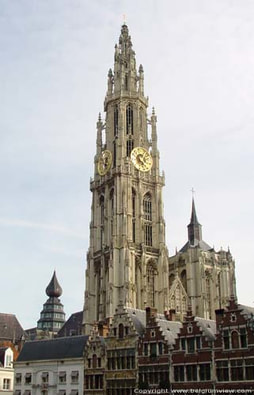
"O Lieve Vrouwetoren" refers to the tower of the Cathedral of Our Lady in the Belgian city of Antwerp. The cathedral was built between 1352 and 1521, and its northern tower, that reaches a height of 123 meter, is the highest church tower of both Belgium and the Netherlands. At that time, when no high buildings were being built, the tower of the cathedral was a pinnacle of design, a signpost to God.
|
The tower of the cathedral was the means of communication between the city and its inhabitants: it's clock indicated the time, the bells called for the service, the carillon was the cultural medium for poor and for rich. But it also indicated where the cathedral was to be found, the cathedral that was a representative of the church that provided the possibility for studying (de papenschool), and for learning music (het Choraelhuys), that took care of the poor (The table of the Holy Spirit), the sick (Our Lady Hospital), and of the dead.
The tower witnessed how the cathedral was visited by believers, how it became victim of the iconoclasts (1566-1581), how it was almost completely emptied from all valuable items by the French troups at the end of the 18th century, and how, during the same period, the cathedral was even threatened to be demolished, as it was seen as a monument and a symbol of the Ancien Régime. |
|
The demolishion of the cathedral could be prevented, it even was partially restored to its former glory. An attempt was also made to restore the magnificent slender tower, but to the end of the 19th century it became clear that the cathedral's tower was in such a bad shape that a complete repair was inevitable. The damage to the tower appeared not only to be caused by erosion, but also by the movement of the tower during the storms, and especially during the ringing of the bells.
|
The repair of the tower started in 1928. The chiming bells were hung in a construction of the reinforced concrete. During the 1930s a start was made with the repair of the city carillon and the clock, but because of the economic crisis and the beginning of the Second World War the works were delayed. In the years 1950-1958 the eight supporting pillars were strengthened, and the carillon chair was renewed.
Yet it was the stone construction that needed the most care. Though this construction had been taken care of during the previous repairs, it soon appeared that it needed a new restoration. That was started in 1975 and lasted till 1989, when the cross, the weathercock and the steeple clock were finally fastened to their original place. In 1990 the stands could finally be removed, after the restoration period of three quarters of the century. As mentioned earlier, the tower of the Cathedral of Our Lady is the highest building of Antwerp, and often there is being refered to its hight in order to understand the scale and the impact of other projects in the city. For example, the height of the Lange Wapperviaduct (150 m), part of the original Oosterweel connection project, was compared with the cathedral height. |
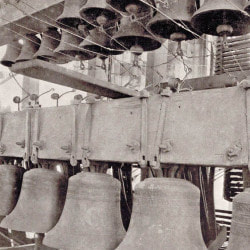
The bells of the carillon
|
In the 19th century youth novel "Een hond van Vlaanderen", (A dog of Flanders), by Ouida, the poor boy Nello and his dog Patrasche visit the Antwerp cathedral and fulfill an old dream by looking at a painting by Peter Paul Rubens. In Japan the book is a larger literary classic than in Belgium and many Japanese tourists also visit the Antwerp cathedral to look at the painting by Rubens. In this setting the cathedral also plays an important role in the Suske en Wiske album The threatening thing. In this album, which is entirely dedicated to the aforementioned youth novel, the dinges photographed in the cathedral an appearance of Nello and Patrasche.
|
How the carillon is automatically operated
|
Manual operation of the carillon
|
|
Dutch text
als een wachter aan de Schelde staat gij in weer en wind heersend over stad en velden die de stroom tot één verbindt als een baken in de baren, blijft gij steeds het zinnebeeld dat vooruitgang en welvaren over Vlaanderen verdeelt oh Lieve Vrouwe Toren hoog boven 't Vlaamse land wij zijn in uw schaduw geboren zo hecht aan u verwant nooit zullen wij vergeten de dapp're gouden haan voor u, lieve toren zal steeds ons hart slaan blijf daar voor eeuwig staan uit de stad van de sinjoren rijst gij op, zo slank van lijn laat uw bronzen klokken horen als ons daag'lijks liefst refrein veel geheimen moet gij borgen uit 't verleden en van nu want uw kind'ren met hun zorgen wenden zich vol hoop tot u oh Lieve Vrouwe Toren hoog boven 't Vlaamse land wij zijn in uw schaduw geboren zo hecht aan u verwant nooit zullen wij vergeten de dapp're gouden haan voor u, lieve toren zal steeds ons hart slaan blijf daar voor eeuwig staan |
English text
At the Scheldt in wind and weather Like a guardian you stand And control them altogether: Regions of the river bend. Like a beacon in the waters, Flanders always you sustain, Symbolizing the headquarters Of the progress, wealth and gain. O Dear Lady`s Tower Above the Flemish land We have been born in your high power We heed your guiding hand We never will ignore The bravest golden cock For you, dear tower The Flemish hearts knock Forever work your clock! From the Antwerp downtown You raise up, slim like a line. Every day your bells, bronze-brown, Bring us their lovely chime. Lots of secrets you must know, In all epochs they are born. As your hopeful children flow, Telling you, what`s the concern. O Dear Lady`s Tower Above the Flemish land We have been born in your high power We heed your guiding hand We never will ignore The bravest golden cock For you, dear tower The Flemish hearts knock Forever work your clock! Translation by accordeonworld |
Sources:
https://muzikum.eu/nl/123-1204-23889/la-esterella/oh-lieve-vrouwe-toren-songtekst.html ;
https://nl.wikipedia.org/wiki/Oh_Lieve_Vrouwe_Toren; https://nl.wikipedia.org/wiki/La_Esterella ;
https://nl.wikipedia.org/wiki/Onze-Lieve-Vrouwekathedraal_(Antwerpen) ; https://www.discogs.com/artist/1128123-Johnny-Steggerda ;
https://secondhandsongs.com/artist/38334; https://vivavlaanderen.radio2.be/la-esterella/artikel/01-01-1951/868 ;
http://www.gva.be/cnt/aid1465561/la-esterella-br-oh-lieve-vrouwetoren ;
http://www.pienternet.be/pano/kathedraal/info.html ;
http://www.tento.be/OKV-artikel/de-onze-lieve-%E2%80%93vrouwekathedraal-antwerpen
https://muzikum.eu/nl/123-1204-23889/la-esterella/oh-lieve-vrouwe-toren-songtekst.html ;
https://nl.wikipedia.org/wiki/Oh_Lieve_Vrouwe_Toren; https://nl.wikipedia.org/wiki/La_Esterella ;
https://nl.wikipedia.org/wiki/Onze-Lieve-Vrouwekathedraal_(Antwerpen) ; https://www.discogs.com/artist/1128123-Johnny-Steggerda ;
https://secondhandsongs.com/artist/38334; https://vivavlaanderen.radio2.be/la-esterella/artikel/01-01-1951/868 ;
http://www.gva.be/cnt/aid1465561/la-esterella-br-oh-lieve-vrouwetoren ;
http://www.pienternet.be/pano/kathedraal/info.html ;
http://www.tento.be/OKV-artikel/de-onze-lieve-%E2%80%93vrouwekathedraal-antwerpen
