Oi, da ne vecher

|
"Oi da ne vecher", which means "Oh, at this evening", are the first words of the lyrics of a Russian folk song that is also known as "The cossack's parable" or "Stenka Razin's dream.
Stenka Razin (1630-1671)was a very popular figure in Russia, as we told in our comment on the song "Stenka Razin", and it is obvious that quite some songs were written about this cossack leader. The song "Oi da ne vecher" tells about Stenka Razin having a dream, in which he was told that his head would be cut off and that all his cossacks would flee. Stenka tells this dream to a captain of his troups, who explains that it as an omen of their defeat. |
And indeed, Razins revolt could not stand in the long run and he lost several battles. When the Patriarch of Moscow banned him, many of his followers and the Don Cossacks turned against him.
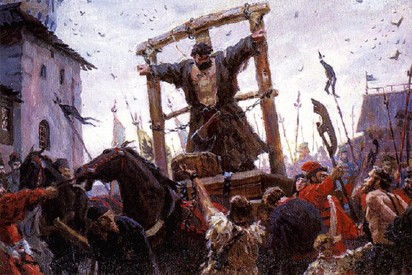
In 1671 Stenka Razin and his brother Frol were caught in Kaganlyk, the last fortress that was in his possession. Razin was transferred to Moscow, where he was sentenced after torture to death by quartering.
The execution took place on the Red Square on June 16th (6th?) 1671.
In 1671 Stenka Razin and his brother Frol were caught in Kaganlyk, the last fortress that was in his possession. Razin was transferred to Moscow, where he was sentenced after torture to death by quartering.
The execution took place on the Red Square on June 16th (6th?) 1671.
The song was first published by Alexandra Zheleznova-Armfelt. She was a Finnish-Russian composer who got married in 1895 to a Russian officer of Ural cossack descent. It was because of this marriage that Alexandra Zheleznova got interested in the cossack songs. During the period 1896-1897 she did fieldwork in the Ural region, that provided her the material for a collection of songs of the Ural Cossacks. The lyrics to the songs were dictated by old Cossacks.
|
The song "Oi da ne Vecher" has several variants, and though the original version counts 7 verses, sometimes it is expanded up to 11, in other occasions it only has four.
Nevertheless, the lyrics always do tell the same story: it is not evening yet, I had a dream that tells me that my black horse gets wild and that my head will "come off". During the 20th century the song became very popular. It was performed a.o. in the rock opera "The legend of Yemelyan Rigachev" (1978), Arkona (2004), Valery Kipelov (2011). The performance of Andrey Zheleznyakov became known internationally as the intrance theme used by Fedo Emilianenko, a Russian heavyweight mixed martial artist. |

|
sources: https://en.wikipedia.org/wiki/Oy,_to_ne_vecher
https://www.jamendo.com/album/44920/oi-da-ne-vecher-single
http://lyricstranslate.com/en/oy-da-ne-vecher-oi-da-ne-vecher-oh-evening.html?destination=node%2F221091#ixzz41sfvjKim
http://lyricstranslate.com/en/oy-da-ne-vecher-oi-da-ne-vecher-oh-evening.html#songtranslation#ixzz41sgz0vKh
https://www.jamendo.com/album/44920/oi-da-ne-vecher-single
http://lyricstranslate.com/en/oy-da-ne-vecher-oi-da-ne-vecher-oh-evening.html?destination=node%2F221091#ixzz41sfvjKim
http://lyricstranslate.com/en/oy-da-ne-vecher-oi-da-ne-vecher-oh-evening.html#songtranslation#ixzz41sgz0vKh
|
|
|
|
Russian Text
Ой, то не вечер, то не вечер, Мне малым-мало спалось, Мне малым-мало спалось, Ох, да во сне привиделось... Мне во сне привиделось, Будто конь мой вороной Разыгрался, расплясался, Разрезвился подо мной. Налетели ветры злые Со восточной стороны. Ой, да сорвали чёрну шапку С моей буйной головы. А есаул догадлив был -- Он сумел сон мой разгадать. "Ох, пропадёт, — он говорил, Твоя буйна голова." Ой, то не вечер, то не вечер, Мне малым-мало спалось, Мне малым-мало спалось, Ох, да во сне привиделось... Ох, да во сне привиделось... Ох, да во сне привиделось... |
English text
Oh, at this evening, at this evening, I was sleeping so small time, I was sleeping so small time, Oh, and I saw in my dreams... I saw in my dreams, That my horse (black as crow) Was like crazy Under my saddle. Oh, evil wings came From the east side Oh, and disrupted black cap From my head. But my esaul* was clever He understood and explained my dream “Oh, you will lose”-He said You will lose your head” Oh, at this evening, at this evening, I was sleeping so small time, I was sleeping so small time, Oh, and I saw in my dreams |
